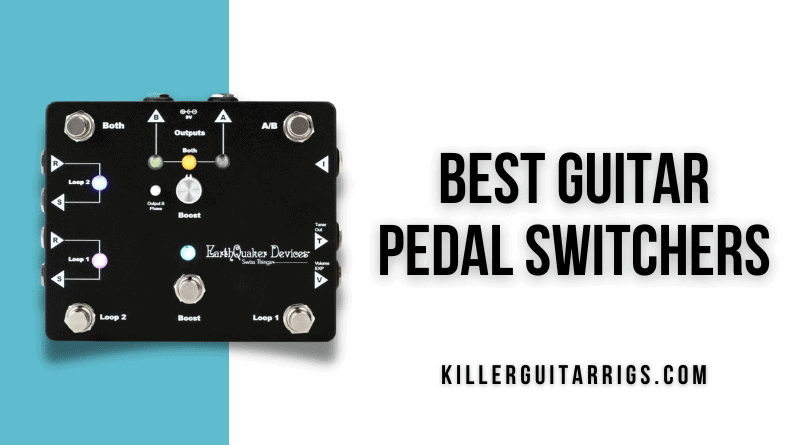
The best guitar pedal switchers can make things much easier for you when it comes to managing your effects and setup. These fantastic tools are often the best solution for tidying up your sound and performance.
Besides allowing you to better organize your effects into one convenient unit, pedal switchers are also of great help for changing sounds quickly during a song. For instance, activating your fuzz, flanger, octave and reverb pedals at the same time would mean stepping on four different pedals.
Not only is that inconvenient, but it can detract from a performance if you want to activate that particular sound for say… just the chorus. In any case, pedal switchers can do that with a single press of a switch.
Naturally, there are tons of models and types of pedal switchers out there. With so many options, where do you even begin? Keep reading. We’ve got you covered.
Read more about our review process.
Boss ES-8
Features: D800 Patch memory, Switch-noise mute capability, Customizable pedal function assignments
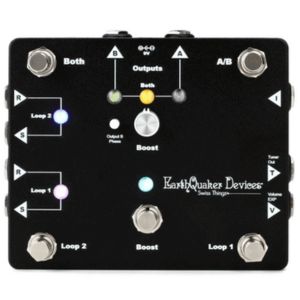
EarthQuaker Devices Swiss Things Pedalboard Reconciler
Features: AB-Y Routing, Expression Pedal Input, Built in clean boost
Benefits: Excellent signal integrity, Multi function versatility, Compact footprint
On-Stage GSP1000
Features: Slip-resistant rubber backing, All metal construction, True bypass switching
Benefits: Low noise, Fits easily on pedalboards, Preserves tonal character
Contents
Our Top 3
The EarthQuaker Devices Swiss Things Pedalboard Reconciler is our Top Choice for this list. This is a convenient unit that features loop switching, clean boost with up to 20 dB of gain, and AB-Y routing.
Next up, the On-Stage GSP1000 ABY Switcher Pedal is our choice for Best Budget. With a compact and convenient size, you can use it to toggle between clean and dirty amps, as well as blend wet and dry signals.
Finally, the Boss ES-8 Effects Switching System is our Editor’s Choice.
This system provides a comprehensive solution for managing your effects, amps, routing and more, with eight loops, 800 patch memories and an analog circuit design for superior tone.
Individual Reviews
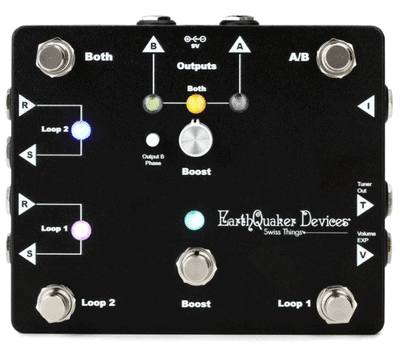
EarthQuaker Devices Swiss Things Pedalboard Reconciler
A simple pedal switcher that delivers everything you need.
EarthQuaker Devices is known for offering unique sounds in well-built pedals. The Swiss Things pedal switcher offers quality and a very intuitive design that helps you consolidate your effects into one convenient pedal to operate them.
The EarthQuaker Devices Swiss Things Pedalboard Reconciler is a convenient and compact pedal switcher that features loop switching, clean boost with up to 20 dB of gain, and AB-Y routing.
Well-built and quite sturdy, this pedal offers simplicity and ease of use while remaining versatile. It does not take as much space as many other pedal switchers on the market, yet offers great functionality to manage your effects in a more seamless manner.
We put this pedal switcher to the test by connecting our MXR Carbon Copy delay and TC Electronic Hall of Fame Reverb to the buffered loop, and our EHX Big Muff Fuzz to the unbuffered loop. Both the delay and reverb pedals performed nicely, with great signal quality.
On the other hand, we did not experience any noise issues with our Big Muff Fuzz, even at high volumes. We also loved that we were able to switch each loop independently, providing fantastic flexibility.
For these tests, we took advantage of the dual outputs on the Swiss Things by connecting the A output to our Fender Twin Reverb and sending B to our Roland JC-120. We were able to use the A/B switch to toggle between them at will, using the Roland for cleaner tones and going to the Twin Reverb for distorted sounds.
We also tried both at the same time for some nice clean tones on stereo. The Swiss Things has a switch labeled “Both” for engaging both amps conveniently and immediately. Our signal integrity was nicely preserved thanks to the transformer-isolated outputs
In short, a fantastic pedal switcher that offers everything you need to manage your effects seamlessly. This unit is easy to use and built like a tank, with great care given to superior tone at all times.
Verdict: The EarthQuaker Devices Swiss Things Pedalboard Reconciler is a well-built and easy-to-use pedal switcher. It features two different effect loops, a clean boost, AB-Y routing, and a buffered tuner out, offering you fantastic features to make your effect-switching easier.
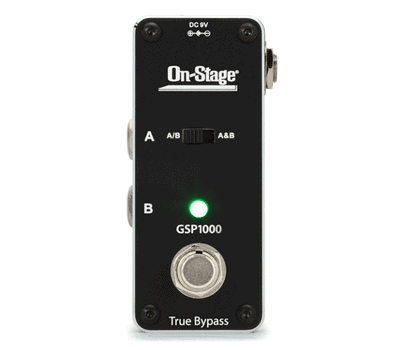
On-Stage GSP1000 ABY Switcher Pedal
A compact unit that will fit just about anywhere.
A well-built and truly small unit that can easily take care of your ABY needs. It is sure to fit on tight pedalboards and gives you a great solution for running a setup that involves two amplifiers.
The On-Stage GSP1000 ABY Switcher Pedal comes in a mini-pedal format, offering fantastic convenience while fitting in the palm of your hand. In other words, it will fit on severely cramped pedalboards, since you can literally fit it in your back pocket if need be.
With the GSP1000, you can toggle between clean and dirty amps, as well as blend wet and dry signals. This unit runs on a standard center-negative 9V power supply and features a low <20 mA current draw.
For our tests, we sent one output on this tiny ABY switcher to our Marshall DSL40CR 1×12″ running on its ultra-gain channel for heavy distortion. The other output (B) was sent to our Fender Twin Reverb running on clean with a good amount of reverb. We played through our Fender Strat at all times.
We really liked how simple and easy to use this pedal is. It gave us a straightforward solution for running a two-amp setup while preserving our tone. The Marshall gave us its gnarly distortion and the Twin Reverb gave us its characteristic gorgeous clean sound. In reality, it’s like the GSP1000 was not even there, as it did not color or muddy our tone in any way.
Besides being convenient and a great tool for running through two amps, this unit is very well-built and comes in a rugged black anodized aluminum chassis. We also liked the rubber on the bottom of the pedal, especially as we set it on a tile floor. There was no slipping and it remained in place at all times.
In short, an easy and affordable pedal switcher that allows you to split or combine signals as you see fit.
Verdict: The On-Stage GSP1000 ABY Switcher Pedal has the size of a mini-pedal and gives you fantastic convenience in a well-built unit. It is a great choice for running two-amp setups, but you can also use it for any other applications that involve ABYing.
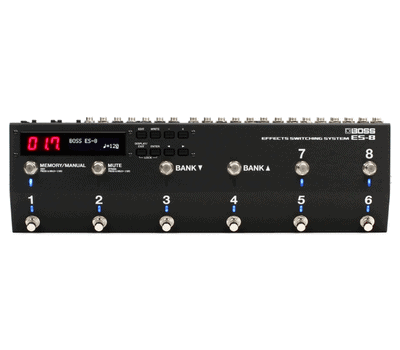
Boss ES-8 Effects Switching System
A comprehensive and detailed solution for controlling your effects.
Few companies have the pedigree that Boss does when it comes to stompbox effects. They have been at the game for decades, and it is only logical that they also offer a fantastic solution for managing diverse and complex effects loops, with extensive routing options.
The Boss ES-8 Effects Switching System offers a comprehensive solution for managing your effects, amps, routing, and more. It gives you eight loops, 800 patch memories and comes with an analog circuit design to preserve your tone.
This pedal switcher also allows you to switch buffers on and off individually each for input and output, so you can pick what’s right for your pedals.
We put his pedal to the test by creating six effects loops including modulation, time-based, overdriven, fuzz with delays, etc. We routed our Strat to a two-amp setup consisting of a Twin Reverb and a Roland JC-120.
We started our tests in Manual mode, where we were able to activate our pedals much like with a conventional pedalboard. This unit preserved the quality of our tone, whether we used the Roland or Fender amp separately or together.
In Manual mode, we saw just how easy to use the ES-8 can be, as well as its fantastic build quality, with sturdy switches and a well-designed and nicely-spaced front pane.
However, Memory mode is where the ES-8 turns into a beast. We were able to save some loop combinations to retrieve with their 100 banks that offer an impressive 800 presets. We also loved that Boss included several inputs for control pedals and expression pedals in order to give a complete one-stop spot for managing complex pedalboards.
In short, a fantastic pedal switcher that gives you everything you could possibly need and more, with deep routing and editing options. This is a great choice for the dedicated professional that is detail-oriented.
Verdict: The Boss ES-8 Effects Switching System offers a comprehensive solution for managing your effects, amps, routing and more. It gives you eight loops, 800 patch memories and comes with an analog circuit design to preserve your tone.
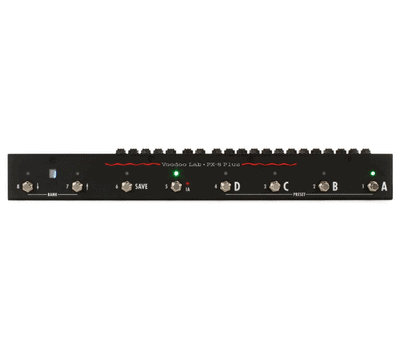
Voodoo Lab PX-8 Plus 8-loop Pedal Switcher
A space saving switcher that doesn't sacrifice on functionality.
Voodoo Labs handbuilt this pedal switcher with great attention to detail at their California factory. It features a smart design that does not take up much space on your pedalboard and is quite durable.
The Voodoo Lab PX-8 Plus 8-loop Pedal Switcher comes in a clever form factor to maximize your pedalboard’s space while giving you eight true-bypass audio loops. You can also customize up to 36 preset tones and access them with a single stomp for greater convenience.
In case you want to go really big, the PX-8 allows you to recall an impressive 128 preset combinations of effects via MIDI. This unit also comes with an output buffer for preserving your tone with long cables going to your amp.
We started our tests with the PX-8 in Standard mode. Here we were able to insert and remove effects at will, conveniently. Standard mode proved to be a perfectly fine way to use this effect switcher for simpler setups.
At first, we used only three of the eight available effect loops, with the last one having our fuzz. Switching them on and off was a breeze, and we loved how sturdy and quiet the switches on the PX-8 were. This unit offers true bypass and we were happy to verify that even our fuzz-effect loop went unnoticed when on bypass.
We then moved into Preset mode, where we created more elaborate effect loops for stuff like lead tones, shimmering cleans, and more. We were able to pull up a string of effects with a single stomp, for great convenience.
The PX-8 also features an insert point between loops six and seven for adding a volume pedal, making a complete solution. As good as it is, this unit does not provide the option of running a two-amp setup, which may be a bummer for some.
Verdict: The Voodoo Lab PX-8 Plus 8-loop Pedal Switcher features eight true-bypass audio loops and up to 36 customizable preset tones on a clever design that maximizes your pedalboard’s space. With quiet Switching technology for low noise and a five-year warranty, this pedal switcher delivers.
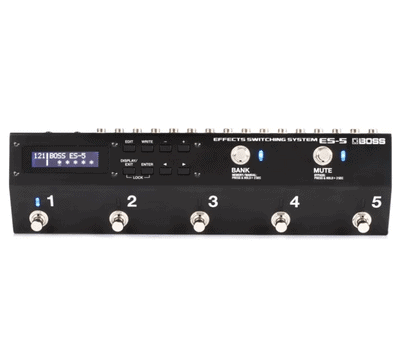
Boss ES-5 Effects Switching System
Renowned quality to simplify your effect switching
With Boss quality and functionality, this unit is a smaller version of the ES-8. It features a similar design and ease of use, making it a good choice for managing your effects.
The Boss ES-5 Effects Switching System features five loops that allow you flexible routing and can give you up to 200 patch memories for instant recall. It features a similar operation as its bigger brother the ES-8, but in a more compact unit.
We tried the ES-5 with our Strat going into our Fender Twin Reverb. Unlike the ES-8, this unit only has a single output so you cannot go stereo with two amps, which limits the ES-5 a bit.
However, if you don’t need a two-amp operation, this unit has a lot to offer. We started our tests by creating four different effect loops. We were happy to verify that the ES-5 gave us a great tone at all times thanks to its all-analog circuit for preserving sound.
Switching in and out of the effect loops was easy, with no discernible noise for our fuzz loop or our clean-effect combinations. We also liked how the LCD display gave us nice visual feedback on what we were doing with our feet.
The ES-5 also allows you to plug in control and expression pedals, and offers MIDI compatibility as well. We also really liked that the loop foot switches are on a panel that is tilted toward the player. This makes them more comfortable for folks that sit down to play, like in the studio, for instance.
In short, a well-built pedal switcher with the high quality that we’ve come to expect from Boss, and a more affordable (albeit more limited) alternative to the ES-8.
Verdict: The Boss ES-5 Effects Switching System gives you five loops and up to 200 patch memories for instant recall. With onboard memory for storing external control parameters and customizable pedal functions, you get plenty of flexibility to control your effects.
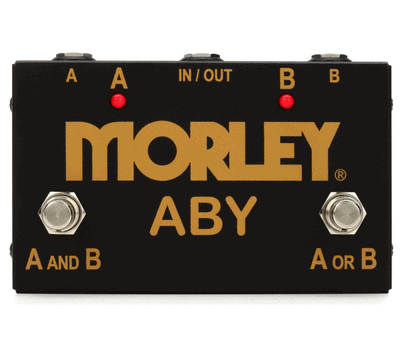
A convenient and straightforward signal switcher.
Morley has been providing quality solutions for musicians for a long time. The ABY switcher is no exception and brings nice quality and functionality to a simple, useful and flexible unit.
The Morley Gold Series ABY 2-button Switcher/Combiner is a flexible unit that can be used in a variety of ways. You can use it with two inputs/one output or with one input/two outputs.
We loved how easy to use the ABY is, with two clearly labeled footswitches. The first is “A or B” for picking between one amp or the other. The second footswitch is “A and B” for engaging both amplifiers at the same time. Foolproof is an understatement!
We started our test with one of the most common and likely uses for this unit: dual amp stereo setup. For this, we used our Roland JC-120 for running clean tone and our Marshall on its high-gain channel for distortion.
By stepping on the “A or B” footswitch, we toggled between our clean Fender and our distorted Marshall with ease. There was no crackling or any other unwanted noises, and we loved the flexibility and quality that this option gave us.
We then switched off the distortion on the Marshall and stepped on the “A and B” switch for a nice and open stereo sound. On all of our tests, we got zero bleed-through between channels, thanks to the quality circuitry of the ABY.
In short, a well-built signal switcher can be used in different ways, including plugging in two instruments and sending them to one amp, or sending one instrument to two amps.
Verdict: The Morley Gold Series ABY 2-button Switcher/Combiner is a simple but highly effective unit with bypass switching and durable steel housing. You can use it as a one-input/two outputs or as a two inputs/one-output switcher for great flexibility.
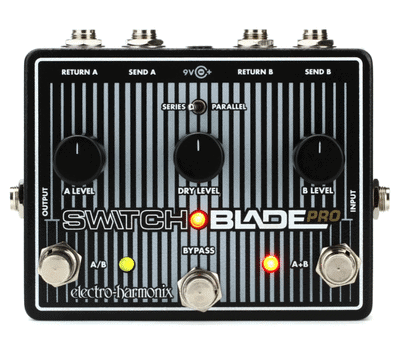
Electro-Harmonix Switchblade Pro Switching Station
An effective, flexible and well-designed ABY switcher.
EHX is among the top pedal brands for guitarists, with great models and a long and storied history. The Switchblade Pro comes with the level of functionality and sturdiness that we all expect from this brand and is a great ABY solution that also gives you versatility.
The Electro-Harmonix Switchblade Pro Switching Station is a flexible and effective ABY signal-switching pedal with fantastic build quality. With this unit, you can run a multi-amp setup, and either toggle or combine two discrete pedal chains for great versatility.
We tried this switcher by setting up a two-amp configuration, using our Roland JC-120 and our Fender Twin Reverb. This was easily done by plugging our Strat into the input jack and directing Send A to the Fender and Send B to the Roland.
Using the “A/B” switch to employ either one or the other amp, and the “A+B” switch for stereo operation was a simple process. We really liked the level knobs for individually controlling the A and B level, as these gave us greater flexibility to get our amp volumes just right without having to go to the amp knobs.
We went to mono operation by sending the output to our Fender, while setting up two effect chains for each of the two available loops on this pedal.
We set up a modulation-effect loop and a fuzz one and got great results with no extra noise added. The switches on this unit are relatively quiet yet sturdy, and you can run them either in series or parallel. Another great feature is the Dry level knob, which allows us to get just the right balance between A and B.
Verdict: The Electro-Harmonix Switchblade Pro Switching Station is a great ABY signal-switching pedal that allows you to switch between two amps or blend them, or do the same with two effect pedal chains. With a passive audio path and sturdy chassis and construction, this is a quality ABY pedal from one of the best in the game.
How To Choose The Right Pedal Switcher for You
Pedal switchers allow you to manage your pedalboard more efficiently, and in a convenient and seamless way. One of the main advantages of these units is that they allow you to activate or deactivate one or several of your pedals with a single click.
This translates into simpler switching, without the need to step on several pedals to achieve your desired sound. The term “tap dancer” is commonly used to refer to folks that are having to step on several pedals at a time to get their sound.
Below are a few things to consider when deciding on a pedal switcher for you. Remember that a solution that is right for one person may not be for you and vice versa. It is important to ask yourself what you need the switcher for and go from there.
Simple or Advanced?
Advanced pedal switchers offer you full programmability, allowing you to save multiple pedal combinations as presets, so you can retrieve them in a split second. This way you can create patches for particular sections of a song, even if they feature several effect pedals that need to be activated at once.
An advanced pedal switcher can act as a one-stop place to control robust pedalboards while giving you plenty of features, routing possibilities, and more. In addition to MIDI inputs/outputs, advanced switchers allow you to connect to a multiple-amp setup, and often offer several control and expression pedal inputs for further control.
Improvement in Tone
Better tone is another reason why pedal switchers are beloved by many. With several pedals connected to multiple cables in one long chain, some of your high-end and overall tonal quality will suffer. This results in a duller tone with less sustain and nobody wants that!
Pedal switchers can remedy that as they offer isolated loops, so the pedals not engaged in a preset won’t factor in, which results in less noise and greater tone preservation. Some pedal switchers also come with built-in buffers for taking better care of your tone, yet another reason why switchers are so valuable.
Price
Pedal switchers can vary greatly in price. Naturally, price is a major factor when buying just about anything, and pedal switchers are no exception. The good news is that there is something for every budget.
Naturally, the more you spend, the more complete your pedal switcher is likely to be. For instance, if you need to run five different pedal loops, want deep editing options, and need two amp setups, you will have to spend more than someone just looking for a basic ABY switcher.
Perhaps a middle-of-the-road pedal switcher can do the job for you. Look at your current pedalboard, consider any near-future pedal purchases, and do your research. Remember that pedal switchers also allow you to get a bit creative with how you want to run your effects and you can use that to your advantage.
Final Thoughts
Pedal switchers can be the difference between an organized, great-sounding, and convenient rig, or a disaster that can make your performance mediocre.
You won’t have to tap dance and press several pedals at once in order to get to your carefully-crafted tones, and your tone will improve. A switcher can also maximize your sound and give you peace of mind.
To recap our top choices, the EarthQuaker Devices Swiss Things Pedalboard Reconciler is our Top Choice for this list. With loop switching, clean boost with up to 20 dB of gain, and AB-Y routing, this is a convenient unit that can handle your switching needs quite well.
The On-Stage GSP1000 ABY Switcher Pedal is our Best Budget choice. Ideal for cramped pedalboards, it comes in a compact and convenient size, providing affordable quality and a straightforward solution to ABY switching.
Finally, the Boss ES-8 Effects Switching System is our Editor’s Choice. This is a great choice for discerning musicians who want greater and more detailed control over effects, amps, routing, and more. It offers eight loops, 800 patch memories, and tons of flexibility.